

Band saw blades are one of the most important consumables in any machine shop, fabrication shop, maintenance department, or woodworking shop. Whether you're replacing a blade on a Horizontal Band Saw, a Vertical Band Saw, or a Horizontal / Vertical Band Saw, selecting the correct blade is only part of the equation. Knowing how to safely handle it and measure its length can prevent injuries, reduce downtime, and extend blade life.
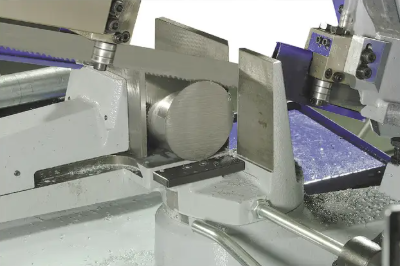
There are many ways to open, fold, and measure a band saw blade. The methods described below are simply the ones I have found to be the safest and easiest for me. You may have a different technique that works well for you.
Band Saw Blade Safety
A band saw blade is essentially a long strip of sprung steel under tension. Even when removed from the machine, the blade stores energy and can quickly spring open if handled incorrectly.
Before handling any band saw blade:
- Wear snug-fitting work gloves that provide cut resistance.
- Make sure there is adequate open space around you.
- When in use, always wear safety glasses or a face shield.
How to Safely Open a Band Saw Blade
Band saw blades are typically shipped and stored folded into at least three loops and are secured with twist ties or zip ties.
Remove the Retaining Tie
With gloved hands, maintain a firm grip on the blade while carefully removing the retaining tie. Do not release the blade until you're ready to unfold it.
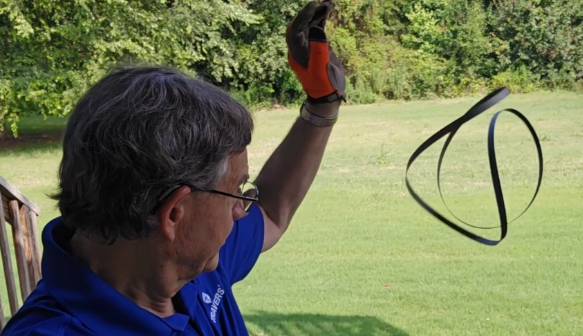
Allow the Blade to Open Slightly
Keeping a firm hold on the blade, allow it to expand slowly instead of letting it spring open.
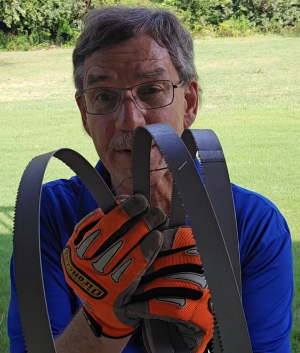
Once the blade has partially opened, carefully toss it away from your body onto a soft surface so it can safely expand to its full size.
Before installation, inspect for:
- Broken, chipped, or excessively worn teeth
- Cracks, especially near the weld
- Kinks
- Rust or corrosion
If you find any damage, replace the blade rather than installing it.
How to Fold a Band Saw Blade for Storage
Properly folding a blade, also called coiling, saves storage space and helps prevent damage or injuries.
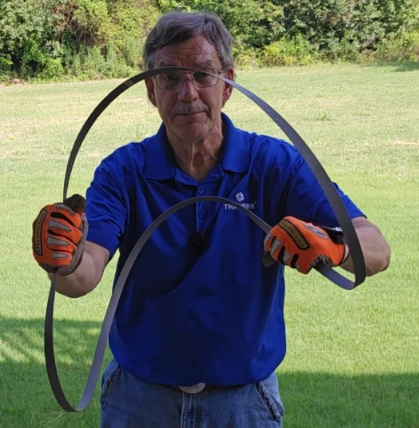
Hold the Blade Vertically
Hold the blade in front of you with its teeth pointing away from your body.
Grip each side of the blade with both palms facing the same direction, either both to your left or both to your right.
Twist the Blade
While applying slight inward pressure, rotate the hand with the palm facing outward.
- The blade will naturally begin forming three loops.
- Do not force the blade.
- Once it starts, it almost folds itself.
Secure the Loops
Once folded into three loops:
- Secure it with a twist tie, wire tie, tape, or another suitable fastener in one or two locations.
How to Measure a Band Saw Blade Length Without Cutting It
Many shops keep several blades, tooth pitches, and styles on hand. Cutting a blade simply to measure it is obviously not a good option.
One simple method is what I call the Roll Measurement Method.
- Draw a line to the edge of two small pieces of masking tape.
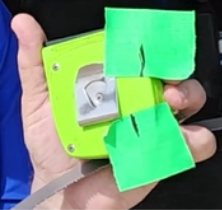
- Place the blade upright on the floor with one foot on it.
COAXIAL INDICATOR INSTRUCTION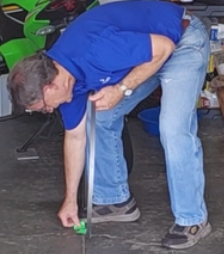
- Mark a line across the inside of the blade.
- Align the first piece of tape on the floor with the mark on the blade.
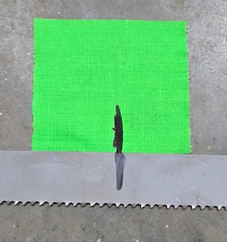
- Roll the blade for one complete revolution. (Stepping on the blade as you walk helps to keep it from slipping.)
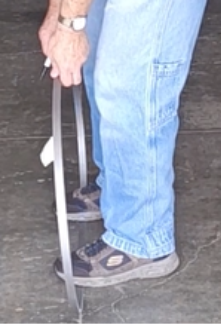
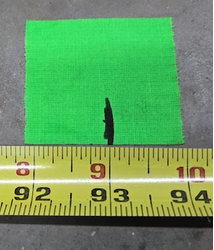
- When the mark reaches the floor again, place the second piece of tape in alignment with it, like you did with the first one.
- Move the blade aside and measure the distance between the marks on the two pieces of tape. The measured distance is the blade's length.
Understanding Blade Length
Band saw blade sizes and lengths may be listed in different formats depending on the manufacturer.
Some manufacturers use inches only.
For example: 64-1/2", 93", 130", 144", etc.
Others list the same blades in feet and inches.
For example: 5 ft 4-1/2 in, 7 ft 9 in, 10 ft 10 in, 12 ft 0 in, etc.
Fortunately, converting between the two is quite simple.
How to Convert Inches into Feet and Inches
- Since there are 12 inches in one foot, divide the total inches by 12.
- The whole number (the number to the left of the decimal) is the number of feet.
(The number on the right side of the decimal does not equal inches. It equals the fraction of a foot.) - Take the decimal and the numbers on the right side of it and multiply by 12.
- Combine (don’t add) the whole number, the decimal, and the result from step 3, and this will give you its length in feet and inches.
Examples from Understanding Blade Length
|
Blade Length |
Conversion Calculation |
Blade Length in Feet and Inches |
|
64-1/2" |
64-1/2 (also written 64.5) ÷ 12 = 5.375 |
|
|
93" |
93 ÷ 12 = 7.75 |
|
|
130" |
130 ÷ 12 = 10.833 |
10 ft 10 in (9.996 is rounded up to 10) |
|
144" |
144 ÷ 12 = 12 |
Key takeaways
How do you safely open a band saw blade?
With gloved hands, maintain a firm grip on the blade while carefully removing the retaining tie. Allow the blade to expand slowly, then toss it away from your body onto a soft surface so it can safely expand to its full size.
How do you fold a band saw blade?
Hold the blade vertically with the teeth pointing away from your body. Apply slight inward pressure while rotating your wrists in opposite directions, allowing the blade to naturally form three loops.
How do you measure a band saw blade without cutting it?
The Roll Measurement Method allows you to measure a band saw blade without cutting it. Mark the blade and the floor, roll it for one complete revolution, and measure the distance between the two marks.
How do you store a band saw blade?
A band saw blade can be folded into three loops and secured with a twist tie, wire tie, tape, or another suitable fastener in one or two locations.
How do you convert band saw blade length from inches to feet and inches?
Divide the total number of inches by 12. The whole number is the number of feet, and the decimal portion is multiplied by 12 to determine the remaining inches.
Final Thoughts
A quality band saw blade is an investment, and proper handling helps you get the most from it. Learning to open a blade safely, fold it correctly for storage, and accurately measure its length are valuable shop skills that improve both safety and efficiency.
Understanding how blade lengths are listed, and how to convert between inches and feet and inches, also makes identifying, organizing, and ordering replacement blades much easier. A few simple techniques can save time, reduce waste, and help your blades deliver the longest possible service life.