

Anatomy of a Cut-Off Wheel Label
All cut-off wheels advise the wheel dimensions and max RPM. It is also common to see additional information about the abrasive material type, grain size, grade, wheel type, or the material the wheel is used on.
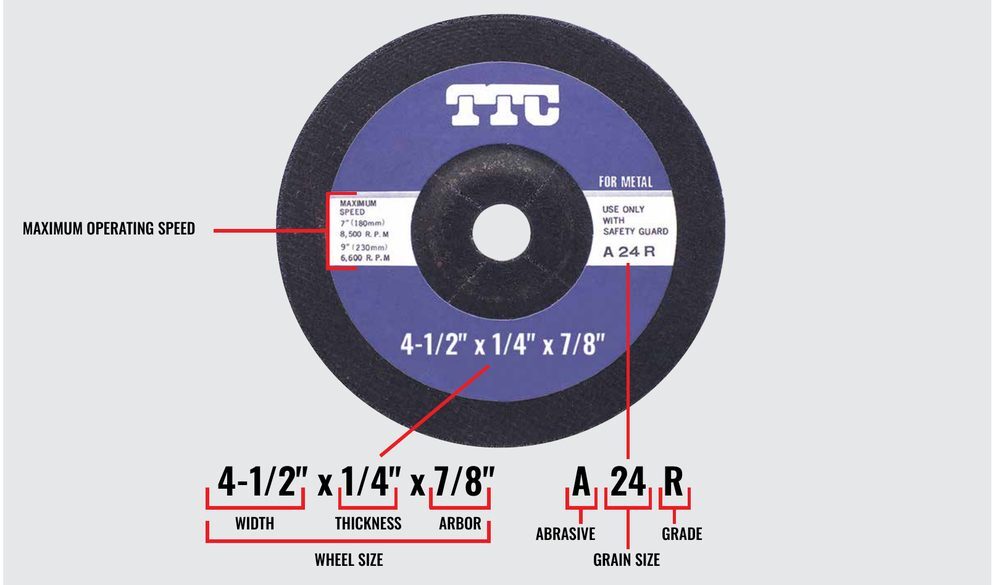
The example label in this guide reads 4-1/2" x 1/4" x 7/8" and A 24 R, with the maximum operating speed printed on the left side of the label. Here is how each marking breaks down.
| Marking | Example | What it tells you |
|---|---|---|
| Wheel size | 4-1/2" x 1/4" x 7/8" | Width x thickness x arbor |
| Maximum operating speed | 7" (180mm): 8,500 R.P.M. 9" (230mm): 6,600 R.P.M. |
The top operating speed, listed by wheel size on this label |
| Abrasive | A | Abrasive material type (A = aluminum oxide) |
| Grain size | 24 | Coarse grain (see the grain size chart below) |
| Grade | R | Hard grade (see the grade chart below) |
The example label also reads "For metal" and "Use only with safety guard."
Safety note: Never exceed the maximum operating speed marked on the wheel, and always check the label on your own wheel for its specific speed rating and warnings.
Common Abrasive Material Types
Aluminum Oxide (A)
The most common and versatile grain. It is blocky and tough, making it ideal for general-purpose cutting of metals, carbon steel, and structural steel.
White Aluminum Oxide (WA)
High friability of this grain gives it the characteristic of fast and cool cutting used for light grinding of steels of all kinds. Particularly on tool steel and stainless steel.
Zirconia Alumina (ZA)
A dense, self-sharpening grain that offers excellent durability. It is excellent for heavy-duty applications on ferrous metals, cast iron, and stainless steel.
Silicon Carbide (C or GC)
A very hard and sharp grain designed for non-metallic materials. Use green silicon carbide for cutting concrete, masonry, stone, glass, and non-ferrous metals like aluminum.
Precision Shaped Ceramic Grain
3M brand specific. It uses proprietary abrasive technology found in heavy-duty sanding and grinding products like Cubitron II and Cubitron 3. Unlike conventional abrasives that "plow" through metal, these uniform, triangular ceramic structures slice cleanly, continuously fracture to maintain sharp edges, and run significantly cooler.
Grain Size and Grade Charts
Grain Size Chart
| Category | Grain sizes |
|---|---|
| Coarse | 8, 10, 12, 14, 16, 20, 24 |
| Medium | 30, 36, 46, 54, 60 |
| Fine | 80, 100, 120, 150, 180 |
| Very Fine | 220, 240, 280, 320, 400, 600 |
Grade Chart
| Hardness | Grade letters |
|---|---|
| Soft | B, D, E, F, G, H |
| Medium | I, J, K, L, M, N, O, P |
| Hard | Q, R, S, T, U, V, W, X |
Wheel Types
The guide includes a wheel type reference for Type 01 and Type 27 wheels, illustrated by profile.

Shop the Tools for the Job
Shop Cut-Off WheelsQuestions? Call 1.800.221.0270 or email sales@travers.com
Frequently Asked Questions
What does "A 24 R" mean on a cut-off wheel?
The first letter is the abrasive (A = aluminum oxide), the number is the grain size (24 is coarse), and the last letter is the grade (R is a hard grade).
What does 4-1/2" x 1/4" x 7/8" mean?
Those are the width, thickness and arbor size, in that order. Together they make up the wheel size.
Which abrasives work on stainless steel?
White aluminum oxide (WA) cuts fast and cool and is used for light grinding of steels, particularly tool steel and stainless steel. Zirconia alumina (ZA) is excellent for heavy-duty applications on ferrous metals, cast iron and stainless steel.
Which abrasive should I use on concrete, stone, glass or aluminum?
Green silicon carbide (C or GC) is designed for non-metallic materials such as concrete, masonry, stone and glass, and for non-ferrous metals like aluminum.
Which grain sizes count as coarse, medium, fine and very fine?
Coarse is 8 to 24, medium is 30 to 60, fine is 80 to 180, and very fine is 220 to 600.
What do the grade letters mean?
Grade runs from soft (B through H) to medium (I through P) to hard (Q through X).