

Machinists often use the terms long length and long reach end mills interchangeably, but each tool is designed for a specific machining purpose. Selecting the correct end mill can improve rigidity, reduce chatter, extend tool life, and produce a better finished product.
A PRACTICAL End mill selection GUIDE FROM TRAVERS TOOL CO.
What Are Long Length End Mills?

Long length end mills (also known as long flute end mills) are the more common of these two style and feature extended flute length and overall tool length compared to standard or long reach end mills. They are designed for machining deeper slots, pockets, cavities, and tall walls where additional cutting depth is required.
Because the cutting flutes are longer, these tools allow greater axial engagement and are well suited for:
- Deep slotting
- Long wall profiling
- Full-depth side milling
- Applications requiring extended cutting reach into the workpiece
The added flute length, however, reduces rigidity. As tool length increases, so do the risks of chatter, tool deflection, poor workpiece surface finish, and tool breakage. To maintain stability and accuracy, machinists often reduce feed rates and cutting forces when using long length tools.
What Are Long Reach End Mills?

Long reach end mills (also known as reduced neck, long neck, or extended reach end mills) are engineered specifically to access hard-to-reach features. They have a reduced neck diameter and shorter flute length, allowing the cutter to extend farther into confined spaces than long length end mills.
Since only a shorter portion of the tool is actively cutting, long reach end mills are generally more rigid than comparable long length tools. This increased rigidity helps reduce chatter and tool deflection while improving dimensional accuracy and surface finish.
The tradeoff is reduced side-cutting capability. Because the flute length is shorter, axial depth of cut is more limited than with long length end mills.
To determine the total reach of a long reach end mill, add the neck length to the flute length.
Note: Flute length may also be referred to as Length of Cut (LOC) or Depth of Cut (DOC).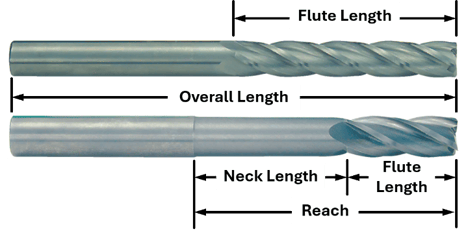
Typical applications include:
- Mold cavity machining
- Deep pocket milling
- Machining around tall walls or obstructions
Choosing the Right Tool?
The best tool depends on the machining objective:
- Choose a long length end mill when deep side milling or extended axial cutting is required.
- Choose a long reach end mill when reaching into deep or restricted areas while maintaining rigidity is the priority.
Long Reach End Mills vs. Long Length End Mills at a Glance
|
Feature |
Long Reach End Mill |
Long Length End Mill |
|
Primary Design |
Reduced neck with shorter flutes |
Extended flute length |
|
Main Purpose |
Reach deep cavities and tight areas |
Machine deep walls and slots |
|
Flute Length |
Shorter |
Longer |
|
Reach |
Excellent |
Good |
|
Rigidity |
Higher |
Lower |
|
Chatter Resistance |
Better |
Poorer |
|
Tool Deflection |
Lower |
Higher |
|
Side Milling Capability |
Limited by flute length |
Excellent |
|
Axial Depth of Cut |
Limited |
Greater |
|
Workpiece Surface Finish |
Usually better |
Can degrade from vibration |
|
Tool Strength |
Stronger near cutting end |
Weaker due to long flutes |
|
Typical Applications |
Mold cavities, deep pockets, aerospace work, etc. |
Deep slotting, profiling, tall wall machining, etc. |
|
Typical Uses |
Use a long reach end mill when you need to reach deep into a cavity. |
Use a long length end mill when you need to machine deep walls or slots. |
General Machining Recommendations
For the best performance and results:
- Use the shortest tool possible
- Minimize tool stickout
- Use the largest practical diameter
- Prefer long reach end mills over long flute end mills when rigidity is critical
Common Machining Terms
Tool Deflection
Tool deflection is the bending or flexing of a cutting tool caused by machining forces. As tool length increases or diameter decreases, the tool becomes less rigid and more prone to bending.
Excessive tool deflection can result in:
- Reduced dimensional accuracy
- Tapered walls
- Poor surface finish
- Increased tool wear
- Premature tool failure
- Chatter
- Increased spindle wear
- Tool breakage
Chatter
Chatter is unwanted vibration during machining. It can produce:
- Loud squealing or rattling sounds
- Wavy or rough surface finishes
- Reduced dimensional accuracy
- Increased spindle and tool wear
- Premature tool failure
Common causes include:
- Excessive tool length
- Too much tool deflection
- Incorrect feeds and speeds
- Poor workholding rigidity
- Weak machine setup
Tool Stickout
Tool stickout, is the distance the cutting tool extends from the holder or collet to the tool tip.
Greater stickout reduces rigidity and increases the likelihood of:
- Tool deflection
- Chatter
- Tool breakage
Relationship Between Stickout, Deflection, and Chatter
These concepts are closely related:
More Tool Stickout → More Tool Deflection → Greater Chance of Chatter
That is why machinists try to:
- Use the shortest possible tool
- Minimize tool stickout
- Use proper feeds and speeds
Reducing tool stickout is often one of the fastest and most effective ways to improve machining stability, surface finish, and tool life.
Pro Tips and Related Resources:
- Learn the fundamentals of end mill types, coatings, tool materials, and helix angles with the downloadable End Mills Guide.
- To learn about helix angles, and what would be best for your application, explore helix angle selection in Choosing The Right Helix Angle For Your Machining Application.
- Watch How To Mill Aluminum: An Introduction To Aluminum Milling Basics for an introduction to aluminum milling basics.
- For milling aluminum, a good choice of end mills is our Rushmore USA 3 flute ZrN coated solid carbide single end mills.
- Solid carbide and indexable tools have their pros and cons. The Solid Carbide Vs. Indexables: Which & When On Aluminum will help you choose the best tool for milling aluminum.
- If you’re having issues with your milling operation, our End Mill Troubleshooting guide can help resolve problems while increasing productivity and tool life.
- The video Steel Milling Guide: How To Mill Steel is a good introduction to steel milling basics.