
Precision measurement is the foundation of quality machining, fabrication, and inspection. A single set of calipers can perform multiple measurement tasks with repeatable accuracy, making them a highly versatile caliper measuring tool. Understanding the four primary measurement methods will help you use your calipers to their full potential and reduce the need for multiple tools on the shop floor.
- To understand dial calipers, refer to our guide on how to read a dial caliper.
- To determine which style best fits your needs—dial, digital, or vernier—refer to our guide on how to choose the right caliper, or explore our top 5 caliper measuring tools for recommended options.
Calipers can measure:
- Outside dimensions
- Inside dimensions
- Depth measurements
- Step measurements
Mastering these four techniques allows machinists, inspectors, and technicians to measure the most common part features using one versatile precision measuring instrument.
1. Outside Jaws: Measuring External Dimensions
Got it—that makes sense. Then you can keep it clean and direct: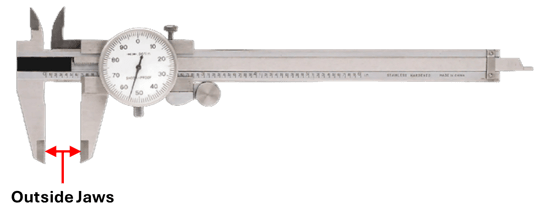
Measuring external dimensions is one of the most common uses of calipers. The larger lower jaws, referred to as the outside jaws, are intended for measuring features such as:
- Outside diameter of shafts
- Thickness of plates or sheet material
- Width, height, or length of components
How to measure:
- Open the caliper jaws wider than the feature being measured.
- Position the jaws around the outside surfaces of the workpiece.
- Close the jaws until they make light contact with the surfaces.
- While maintaining light closing pressure, gently rock or pivot the calipers to locate the smallest reading.
Proper technique is important. Apply consistent pressure and avoid squeezing the jaws, which can distort readings and reduce accuracy.
2. Inside Jaws: Measuring Internal Features
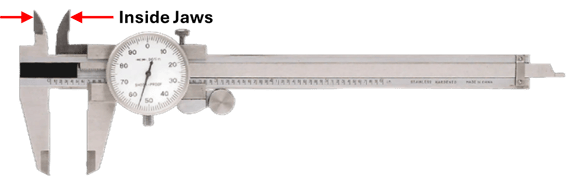
The smaller upper jaws, referred to as the inside jaws, are used to measure internal dimensions such as:
- Bore diameters
- Slot widths
- Internal groove widths
How to measure:
- Close the caliper jaws and position the inside jaws within the opening.
- Gradually open the jaws until both measuring faces contact the internal surfaces.
- Lightly rock the caliper to align the jaws square to the surfaces and locate the largest reading.
- Read the measurement while maintaining light outward pressure.
Internal measurements typically require careful alignment to achieve consistent and repeatable results.
3. Depth Measurement: Using the Depth Rod (or Blade)
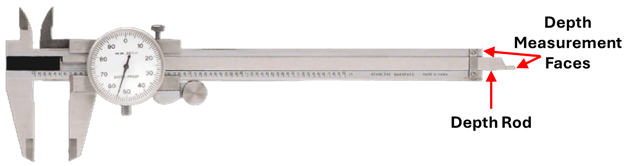
Calipers are equipped with a depth rod that extends from the end of the beam. This feature is used to measure internal, depth-related features such as:
- Hole depths
- Counterbores
- Recessed features
- Groove depths
How to measure:
- Position the depth rod over the feature and extend it downward into the opening.
- Lower the base of the caliper frame until it rests flat on the reference surface of the part.
- Apply light, consistent downward pressure to keep both the frame and depth rod seated.
- Read the measurement while maintaining stable contact.
Keeping the frame flat and stable is critical for accurate depth measurements. Any tilt can introduce measurement error.
4. Step Measurement: Measuring Shoulders and Steps
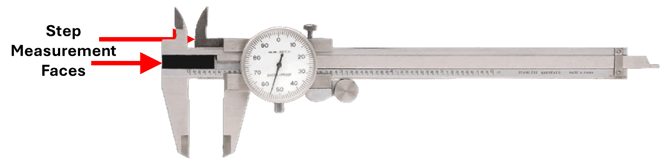
Step measurement is one of the most overlooked capabilities of calipers. It uses the rear faces of the jaws to measure the distance between two stepped surfaces or shoulders.
Typical applications include:
- Measuring shoulder heights on turned parts
- Determining the offset between two machined surfaces
- Verifying step depths on machined components
How to measure:
- Open the movable jaw slightly beyond the step dimension.
- Position the rear face of the fixed jaw firmly against the lower step surface.
- Slide the movable jaw until its rear face makes light contact with the upper step surface.
- Maintain light, even contact on both surfaces and read the measurement from the scale or digital display.
Verify that both measuring faces are fully seated against their respective surfaces while keeping the caliper’s measuring faces aligned parallel to the step surfaces to prevent angular measurement error.
Why These Four Methods Matter
The ability to perform four distinct measurement types with a single tool makes calipers one of the most versatile and widely used instruments in metalworking. From quick in-process checks to final inspection, calipers provide a fast and efficient way to verify part dimensions while maintaining tight tolerances.
For shops seeking to improve productivity and reduce tool clutter, mastering these four techniques ensures you get the maximum value from every caliper in your toolbox.
PRO TIPS FOR ACCURACY & LONG-TERM CALIPER PERFORMANCE
Even high-quality calipers can lose accuracy if they aren’t cared for properly. These practical tips help maintain precision and extend tool life:
- Store calipers properly when not in use
Keep them in their protective case and avoid leaving them exposed on the bench. This helps prevent dust buildup, accidental knocks, and wear on the measuring faces. - Protect against moisture and shop contamination
If calipers are exposed to coolant, chips, or heavy dust, choose models with proper ingress protection. Keeping measuring surfaces clean is essential for consistent accuracy. - Monitor calibration and repeatability
If readings begin to drift or show inconsistency, it may be time for caliper calibration. Regular checks ensure your measurements remain trustworthy, especially in tight-tolerance applications.
Travers Tool Co. has supported machinists and manufacturers for over a century by providing precision tools, application expertise, and dependable service to the metalworking industry.