

Selecting the right lathe chuck isn’t just about its size. It starts with understanding your machine’s spindle. Most typical lathes follow standardized lathe spindle nose configurations that determine how a chuck mounts, aligns, and performs under load. This guide walks through the most common American Standard spindle types, lathe chuck mounting types, and the key decisions you’ll face when choosing a chuck or mounting plate to fit your spindle.
Identifying the Most Common American Standard Lathe Spindle types
The three most widely used spindle nose types are A1 (Short Taper), D1 (Camlock), and L (Long Taper Key Drive). Each has distinct visual and functional characteristics.
A1 Spindle (Short Taper)
- Identification:
- Short locating taper on the spindle nose
- Multiple threaded holes on the face
- No cam pins or long taper key slots
- Mounting Method:
- Chuck or mounting plate (also called an Adapter Plate) is centrally located with a shallow taper
- Chuck or mounting plate is bolted directly to the spindle face
- Common Use:
- CNC lathes and high-speed applications
- Manual lathes in machine shop environments
- Key Advantage:
- Excellent repeatability and rigidity
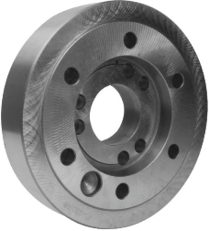
D1 Spindle (Camlock)
- Identification:
- Circular arrangement of camlock studs on the chuck or mounting plate
- Mating camlock holes in the spindle nose
- Mounting Method:
- Quarter-turn cam system locks the chuck or chuck and mounting plate assembly in place
- Common Use:
- Engine lathes, toolrooms, and for general machining
- Key Advantage:
- Fast chuck changes without removing bolts
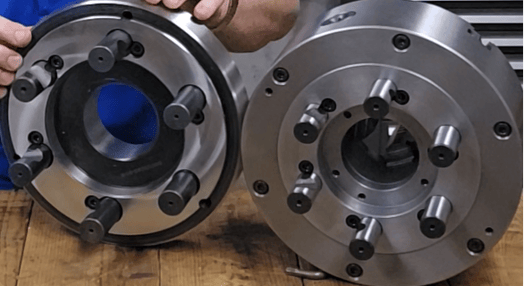
L Spindle (LONG TAPER KEY DRIVE)
- Identification:
- Long taper nose with a keyway
- External locknut that threads onto the spindle
- Mounting Method:
- Chuck and adapter plate assembly slides onto taper, key aligns torque, locknut secures
- Common Use:
- Older heavy-duty lathes
- Key Advantage:
- High torque transmission and strong axial retention
- High torque transmission and strong axial retention
Forged Steel Body vs. Semi-Steel Body
|
Stronger grain structure from forging process |
Made from cast iron or cast steel blends |
|
Higher resistance to cracking under heavy loads |
Good vibration damping |
|
Ideal for CNC, high-speed, or interrupted cuts |
More economical |
|
Typically more expensive |
Best for general-purpose or manual machining |
Universal vs. Adjustable Chucks
Universal (Scroll) Chucks
- All jaws move simultaneously via a scroll plate
- Quick setup and easy operation
- Best for round or hexagonal workpieces
- Limited precision adjustment
Adjustable (Independent or Set-Tru) Chucks
- Adjustable Chucks have jaws move like those on a Universal Scroll Chuck
- The Chuck has fine adjustment for higher accuracy (can dial in near-zero runout)
- Ideal for precision work
- Identified by the seam and four set screws at 90 degrees from each other
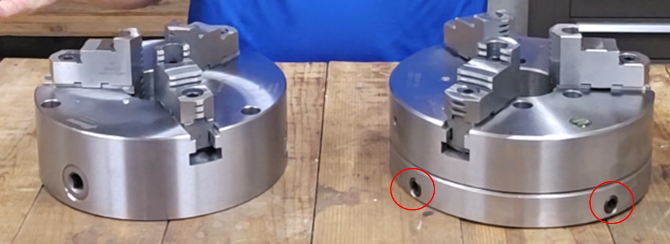
Plain Back vs. Direct Mount
Plain Back
- A plain back chuck has a flat back with no mounting features
- Requires a separate backplate to fit the spindle
- ADVANTAGES:
- Flexible and can adapt to multiple spindle types
- Can be mounted on Rotary Tables, Milling Machines, etc.
Direct Mount
- Chuck is manufactured specifically for a spindle type (A1, D1, or L)
- ADVANTAGES:
- Plug-and-play installation
- Factory-aligned for accuracy
FRONT MOUNT VS. REAR MOUNT
|
Front Mount |
Rear Mount |
|
Chuck is mounted directly to the spindle face |
Chuck is secured from behind the mounting plate |
|
Common in A1 and D1 configurations |
Less common in modern setups |
|
Easier installation and removal |
Provides clean front face with no visible fasteners |
|
Most widely used style |
|
Pro Tip
- When in doubt, don’t rely on visual inspection alone. Measure your chuck or spindle to ensure you get the correct fit.
- Mounting Lathe Chucks on Rotary Tables makes Plain Back chucks much more versatile.
- Knowing How To Choose & Use A Work Stop For Your Lathe is essential for producing consistent, repeatable work.
- If your lathe spindle has a Morse taper, it’s important to know How To Determine Your Machine's Morse Taper Size.
Choosing the right chuck and spindle combination is foundational to machining performance. Whether you're upgrading equipment or replacing a worn chuck, understanding these standards ensures you get the rigidity, accuracy, and safety your operation demands.
Need a quick reference? Download our American Standard Spindle Nose Reference Chart. This downloadable and 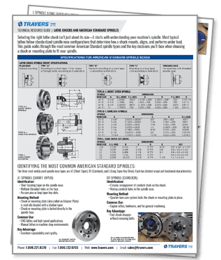 printable chart includes specifications for:
- A1 (Short Taper) spindle noses
- D1 (Camlock) spindle noses
- L-Type (Long Taper Key Drive) spindle noses
- Common lathe spindle types and configurations
- Spindle nose dimensions and reference data
- American Standard spindle nose specifications